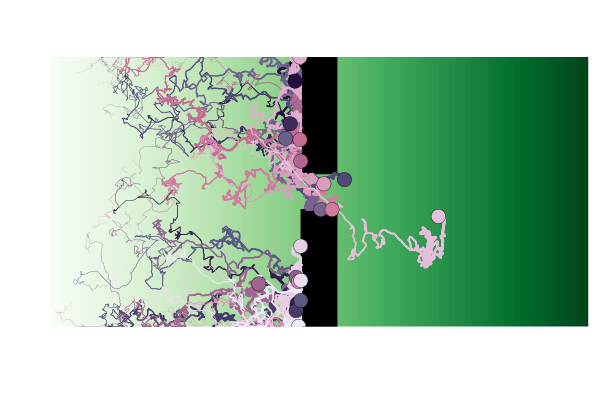
Linear concentration ramp with obstacle
MicrobeAgents can interface with the Agents.Pathfinding module which allows you to perform simulations in spatially structured environments.
The accessible space is represented as a "walkmap", a boolean array where true represents areas that are accessible to the bacteria, and false identifies inaccessible areas. When the pathfinder is included in the model properties, and a pathfinder-aware stepping function is used (MicrobeAgents provides microbe_pathfinder_step! that is fully equivalent to microbe_step! with added pathfinding), the bacteria will perform their motion as usual but will halt when hitting the obstacles.
The pathfinder is suitable when the geometry is naturally discrete or can be well represented on a grid, for instance porous media generated as a walkmap from random packings.
Important: the pathfinder does not support continuous geometries, only discrete representations of them. If smooth geometric features are crucial to your application, this approach is not suitable (see the Obstacles interface).
Here, the pathfinder embeds with all the other functionalities of the library, so we can replicate the chemotaxis example with the linear ramp, with the addition of some obstacles: We will add a vertical wall that prevents horizontal drift along the gradient direction, with only a little hole for bacteria to pass through.
using MicrobeAgents
using Plots

@inline function concentration_field(microbe, model)
    C₀ = model.C₀
    C₁ = model.C₁
    Lx = first(spacesize(model))
    pos = position(microbe)
    concentration_field(pos,Lx,C₀,C₁)
end
@inline concentration_field(pos,Lx,C₀,C₁) = C₀ + (C₁-C₀)*pos[1]/Lx

@inline function concentration_gradient(microbe, model)
    C₀ = model.C₀
    C₁ = model.C₁
    Lx = first(spacesize(model))
    pos = position(microbe)
    concentration_gradient(pos,Lx,C₀,C₁)
end
@inline concentration_gradient(pos,Lx,C₀,C₁) = SVector{length(pos)}(i==1 ? (C₁-C₀)/Lx : 0.0 for i in eachindex(pos))

Lx, Ly = 3000, 1500 # domain size (μm)
periodic = false
space = ContinuousSpace((Lx,Ly); periodic)
Δt = 0.05 # timestep (s)

# model setup
C₀, C₁ = 0.0, 20.0 # μM
wm = BitMatrix(ones(Lx, Ly))
wm[1400:1600, 1:650] .= false
wm[1400:1600, 850:1500] .= false
pathfinder = AStar(space; walkmap=wm)
properties = Dict(
    :C₀ => C₀,
    :C₁ => C₁,
    :chemoattractant => ChemicalField{2}(;
        concentration_field, concentration_gradient
    ),
    :pathfinder => pathfinder
)
model = StandardABM(Microbe{2}, space, Δt;
    properties,
    agent_step! = microbe_pathfinder_step!
)
n = 20 # number of microbes
for i in 1:n
    # start all bacteria in left half of the domain
    x = rand(abmrng(model)) * 700
    y = rand(abmrng(model)) * Ly
    pos = SVector{2,Float64}(x,y)
    motility = RunTumble([30.0], 0.67, Isotropic(2))
    rotational_diffusivity = 0.1
    add_agent!(pos, model; motility, rotational_diffusivity,
        behaviors = (chemotaxis = BrownBerg(),))
end
model

T = 300 # simulation time (s)
nsteps = round(Int, T/Δt)
adata = [position]
adf, mdf = run!(model, nsteps; adata, when=5)

traj = Analysis.adf_to_matrix(adf, :position)
x = first.(traj)
y = last.(traj)

ts = unique(adf.time) .* Δt
lw = eachindex(ts) ./ length(ts) .* 3
xmesh = range(0,Lx,length=100)
ymesh = range(0,Ly,length=100)
c = concentration_field.(Iterators.product(xmesh,ymesh),Lx,C₀,C₁)
heatmap(xmesh, ymesh, c', cbar=false, c=:Greens,
    ratio=1, axis=false, grid=false, xlims=(0,Lx), ylims=(0,Ly)
)
onetonan(x) = isone(x) ? NaN : float(x)
contourf!(onetonan.(wm)', cbar=false, c=:black)
plot!(x, y, lab=false, lw=lw, lc=(1:n)', palette=palette(:acton,size(x,2)))
scatter!(x[end,:], y[end,:], lab=false, m=:c, mc=1:n, msw=0.5, ms=8)